


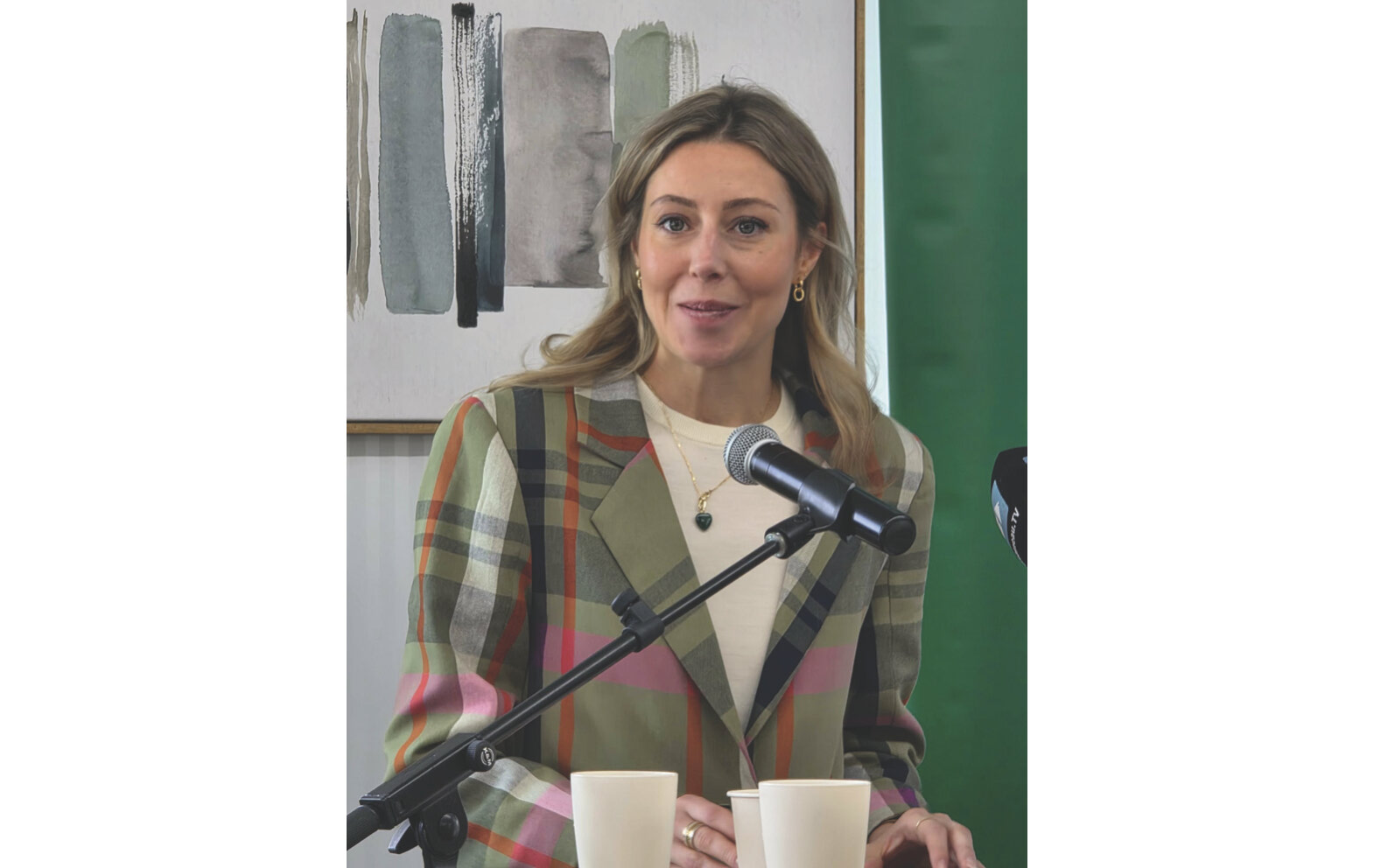
The Observatoire du développement de l'Outaouais released its 2025 annual report documenting research into food access, housing, immigration and climate adaptation across the region, as Gatineau Mayor Maude Marquis-Bissonnette called the institute's work a pillar of the city's future amid ongoing concerns about provincial underfunding. Photo: Tashi Farmilo
ODO report finds Outaouais still falling behind on provincial funding
Tashi Farmilo
The Observatoire du développement de l'Outaouais (ODO), a Gatineau-based research institute mandated to track regional development conditions and hold governments accountable for funding commitments, released its 2025 annual report in March, showing that the Outaouais continues to receive less per-capita public spending than virtually every other region in Quebec and that the gap, far from closing, has been widening.
The ODO is a research institute attached to the Université du Québec en Outaouais whose job is to study local conditions and give decision-makers reliable data to work with. It employs 13 people and is tracking projects ranging from food access and housing to immigration and climate adaptation. In 2025, it launched 12 new projects, held 30 public events and counted more than 9,000 active users on its website.
Coordinator Yves McNicoll pointed to a broader context for that work, noting that the institute's commitment to verifying and sometimes double-verifying its publications takes on particular importance at a time when disinformation is spreading at an alarming rate.
The institute's most closely watched project is its annual accounting of the gap between what the Quebec government spends per person on health, education and culture in the Outaouais compared to the provincial average. A 2019 Assemblée nationale motion formally acknowledged that the region had fallen behind and called for corrective action. The ODO has been tracking whether that promise is being kept. On health, the numbers have been moving in the wrong direction. The cultural spending data, not yet released, is expected in 2026 and will be scrutinized just as carefully.
The ODO's detailed community profiles cover housing, demographics, economic conditions and health indicators across the region. Researchers are now travelling the territory to gather local knowledge from residents that statistics alone cannot capture, with more than 50 such meetings planned before the end of 2026. From that same bank of community data, the institute produced 19 focused profiles for the City of Gatineau identifying seniors at heightened risk of social isolation, with particular attention to anglophone seniors living in minority conditions, a reflection of the region's cross-border character. McNicoll noted that the institute's work serves not only the Outaouais population but also residents of the Laurentides and Montérégie through its participation in a national network of university observatories.
A food access project nearing completion has mapped out which neighbourhoods and rural areas have limited access to healthy food and identified local farmers and distributors who could help address those gaps. The maps were built for simultaneous use by community workers, municipal administrators and elected officials, on the premise that food access cannot be resolved by any single type of institution acting alone. A separate project is building tools to help municipalities plan for climate change, tied directly to the revision of local land-use and development plans.
The institute also completed two projects in 2025. A portrait of immigration in the MRC des Collines-de-l'Outaouais documented the profile of the territory's immigrant population and produced recommendations for a locally adapted integration action plan. A digital portrait of the region's farm sector surveyed producers on their technology use and identified barriers to modernization, with strategies aimed at helping regional development actors support the transition. Two housing bulletins published in January examined conditions in the Ottawa-Gatineau urban area and the region's four rural MRCs separately, reflecting the institute's view that the pressures facing urban Gatineau and rural communities are distinct enough to require distinct treatment.
A new multi-year project is examining how immigrants in the Outaouais fare in the job market, using census data and qualitative interviews with both workers and employers to identify structural barriers to fair integration and document the contributions that newcomers bring to the regional economy. Among the confidential work done for partners, the report notes studies on philanthropy in the Outaouais, the economic impact of Ontario residents occupying units in Gatineau's Plateau district, and analysis supporting the city's proposed tramway.
The ODO's main goal for 2026 is to publish the long-awaited cultural spending data and push several of its larger projects across the finish line. Gatineau Mayor Maude Marquis-Bissonnette, writing in the report, described the ODO as playing a determining role in informing decision-makers, sustaining collective reflection and fostering strong regional dialogue around the issues that matter most to residents. "Your expertise," she wrote to the institute's team, "is a pillar of the Outaouais's future."