


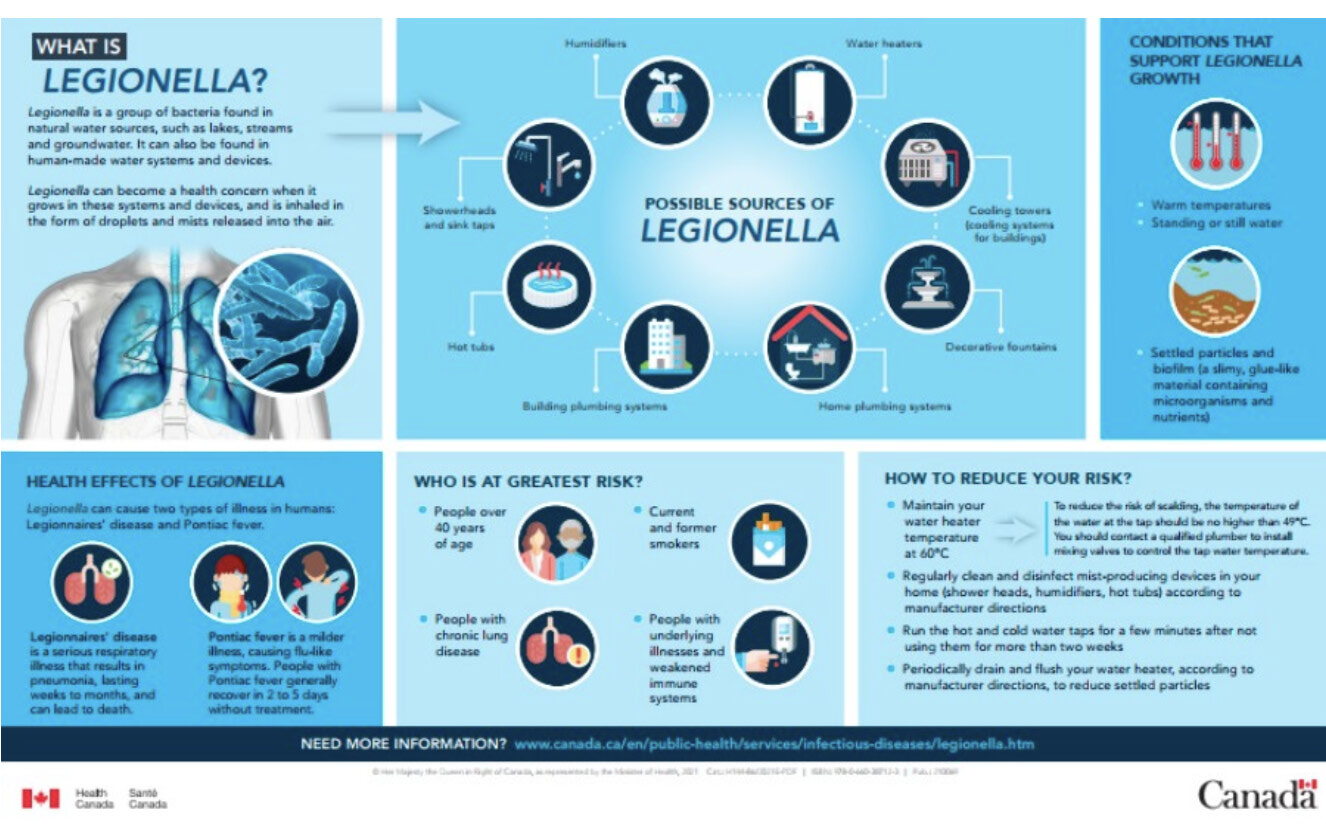
Legionnaires' disease cases in Aylmer have risen to 15 since June 19, more than double the region's usual yearly total, and Santé Québec Outaouais is urging residents to watch for symptoms while investigators work to trace the source. Photo: Courtesy of Health Canada
Legionnaires' disease cases climb to 15 in Aylmer as health officials search for the source
Tashi Farmilo
The number of Legionnaires' disease cases in Aylmer has climbed to 15 since June 19, and Santé Québec Outaouais is urging residents to stay alert while investigators keep working to find where the bacteria are coming from. The regional health authority first raised the alarm on July 15, reporting nine cases among people who live in or had spent time in Aylmer. By July 23, the agency said the total had risen to 15, most of them in the neighbourhood.
That is well above what the region normally sees. Officials say the Outaouais usually records between six and eight cases in an entire year. This time, 15 have turned up in barely a month. The people who fell ill in the first group ranged in age from 25 to 74, with an average age of 55.
Investigators have not yet pinned down exactly where the bacteria are spreading from, but several possible sources in the environment are being examined. The water cooling towers in Aylmer that are registered with Quebec's Régie du bâtiment have been checked and decontaminated, the agency said, and it added on July 23 that clean-up work had been done in some areas linked to known cases. Officials warned that Legionella bacteria can lurk in many everyday water sources, and that more cases could still come to light.
Here is what matters most for people living in Aylmer. Legionnaires' disease, also called legionellosis, is a lung infection contracted by breathing in tiny droplets of contaminated water, from things like cooling towers, water heaters and spas. It does not pass from one person to another, and it cannot be caught by drinking the water. It often looks like pneumonia, and the agency says the warning signs include a high fever, chills, cough, fatigue, headache, muscle aches, chest pain and loss of appetite. Some people also become nauseous, have diarrhea or grow confused.
Most healthy people recover quickly, but Santé Québec Outaouais says 10 to 15 per cent of cases can turn serious. The Public Health Agency of Canada notes that symptoms can appear anywhere from two to 14 days after exposure, and that most cases can be treated with antibiotics if caught in time. The risk of a severe illness is higher for people 50 and over, smokers, and anyone with a chronic lung, heart or kidney condition, diabetes, or a weakened immune system.
The message from health officials is simple. Anyone who lives or has been in Aylmer in the past two weeks and starts feeling these symptoms should not wait it out. Info-Santé 811 or a health professional can help.
At home, one of the simplest ways to lower the risk is to keep the hot water tank turned up to 60 C, with an anti-scald device on the shower and bath taps, and to run the hot water for a few minutes after a prolonged absence or when the tank has gone unused for several days. That keeps the water hot enough to stop the bacteria from taking hold.