


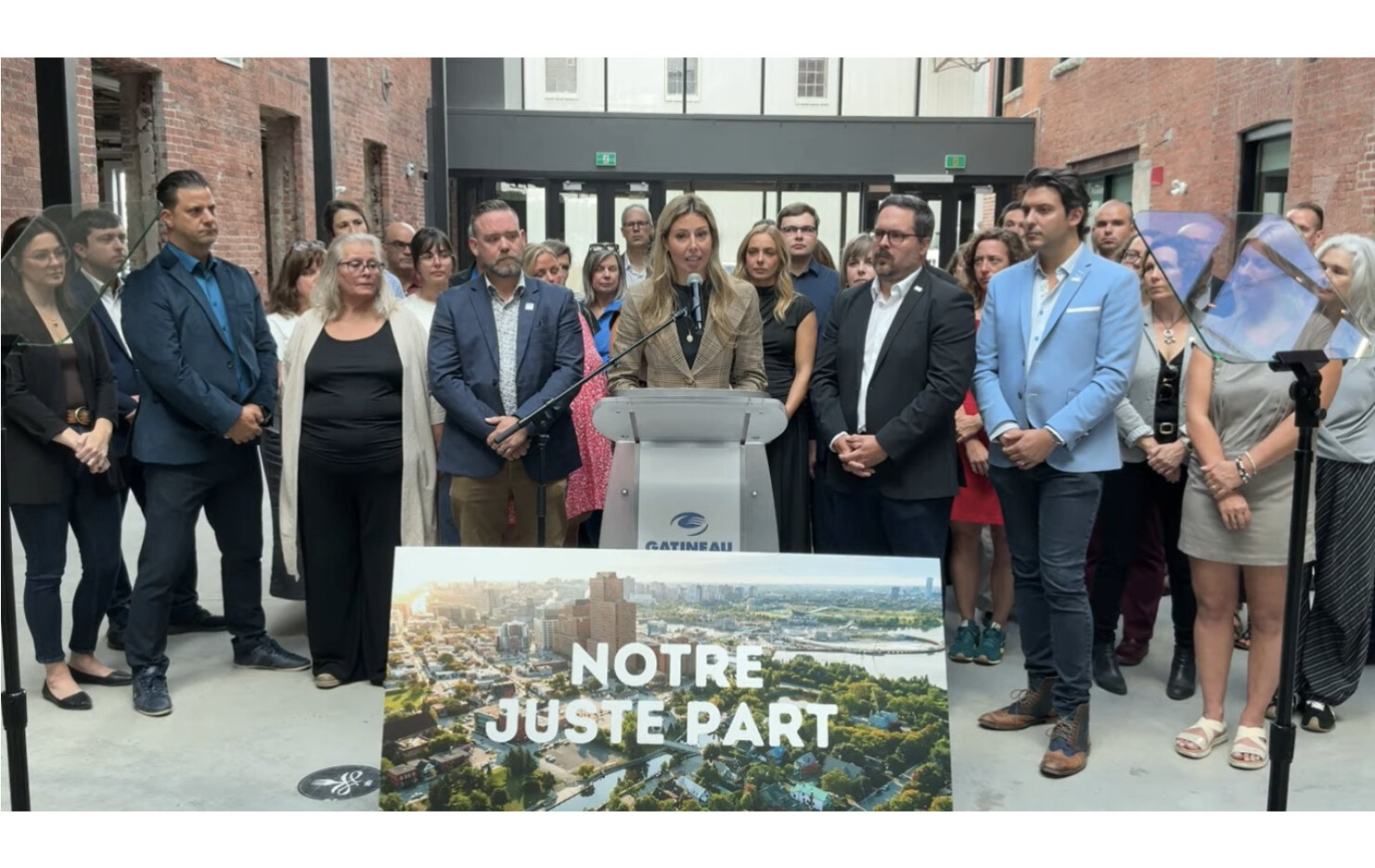
Gatineau's mayor and a coalition of community partners are pressing Quebec's election candidates for the Outaouais's "fair share" of health, education, transit and cultural funding, though opposition and independent councillors say the demands were packaged as the whole city's position without the council's sign-off. Photo: Screenshot of the Press Conference - Priority Commitments for the Provincial Election Campaign, YouTube, Sep 8, 2026
Gatineau presses Quebec's parties for its 'fair share,' as its own council divides over the approach
Tashi Farmilo
Gatineau Mayor Maude Marquis-Bissonnette and a coalition of partners from the health, education, business and community sectors, among them the Cégep de l'Outaouais and the Université du Québec en Outaouais, pressed every party in Quebec's election campaign on September 8 to commit to reversing what they call decades of chronic provincial underfunding in the Outaouais, unveiling a 22-point platform the region wants adopted as a formal 2026-2030 action plan before the October 5 vote.
The document, titled Notre juste part, casts the region's shortfalls as a single pattern rather than a set of isolated grievances. Gatineau is Quebec's third-largest metropolis and a fast-growing contributor to the provincial economy, the mayor argued. Yet it sits only a few hours from the National Assembly while too often, in her telling, being treated as though it were thousands of kilometres away.
Health leads the list and carries the starkest numbers. Per-capita health and social-services spending in the Outaouais sits at about $3,719, the platform says, well below the provincial average of roughly $4,670. Closing that gap would take an additional $272 million a year, by the City's estimate. The region is also the only one in Quebec where many residents routinely depend on another province for specialized care. The platform says the RAMQ pays Ontario institutions an estimated $120 million a year to treat them. It frames the new Gatineau hospital as the centrepiece of any catch-up, and asks Quebec to fund the municipal infrastructure the project will require.
Post-secondary education follows closely. The Cégep de l'Outaouais turned away more than 800 applicants for the 2026-2027 year for lack of space, the platform says. Upward of 7,000 local students crossed into Ontario to study in the fall of 2025. By the City's count, the region offers fewer than half the post-secondary programs of comparable Quebec areas. It ties that shortfall directly to staffing the future hospital and easing the labour crunch.
Transportation put the campaign's stakes in sharp relief. The platform's first mobility demand is simply that Quebec fund the Gatineau-Ottawa tramway. It also seeks long-delayed safety work on Highway 50, an axis flagged repeatedly in coroners' reports. Yet CAQ Leader and Premier Christine Fréchette recently declined to commit to funding the tramway, saying she is awaiting further studies. The mayor called that disappointing, given the analyses that have already confirmed the need.
The platform's other demands reach across several files. On housing, Gatineau carries the highest median rent in Quebec. Homelessness surged faster here than anywhere else in the province between 2018 and 2022. Culture is chronically shortchanged relative to the region's population. Recreation figures too, including two new ice rinks sought for Buckingham. And on municipal finances, the City argues cities are handed responsibilities that far outpace the tax room they are given. The coalition wants all of it folded into a single Outaouais action plan with firm timelines.
Marquis-Bissonnette stressed that the initiative's strength was its breadth. She pointed to the range of groups behind it, from the Chambre de commerce de Gatineau and Centraide Outaouais to Culture Outaouais and health organizations such as Action Santé Outaouais. A coalition this wide, she said, was a first for the region.
The way that unity was presented drew objections from some council members. The platform was released on behalf of the City of Gatineau. Critics said it reflects the priorities of the mayor's party, Action Gatineau, which holds a council majority, more than those of the full council. The opposition Gatineau Ensemble caucus, through councillor Timmy Jutras, said it was never given the chance to weigh in. Independent councillor Michael Korhonen issued a statement during the mayor's remarks, saying he had not been consulted. Marc Carrière, the independent councillor for Pointe-Gatineau, went further in a separate release. He argued that the mayor cannot present the demands as the whole city's when they were never adopted by a council resolution, and pointed to a 2019 vote on regional transport priorities as his model of a legitimate common position. The complaint lands amid a wider argument this campaign, made by opposition municipal parties across Quebec, that elected majorities need stronger checks from councillors free to ask hard questions. None of the Gatineau dissenters, however, took issue with the substance of what the region is asking for.
The mayor rejected the criticism. Speaking at a press conference on September 8, she said every councillor had been consulted and invited, and that the platform grew out of months of work with community organizations. The purpose of the gathering, she said, was to have the region speak with one voice. This time, she added, the Outaouais intends to make itself impossible to ignore.